


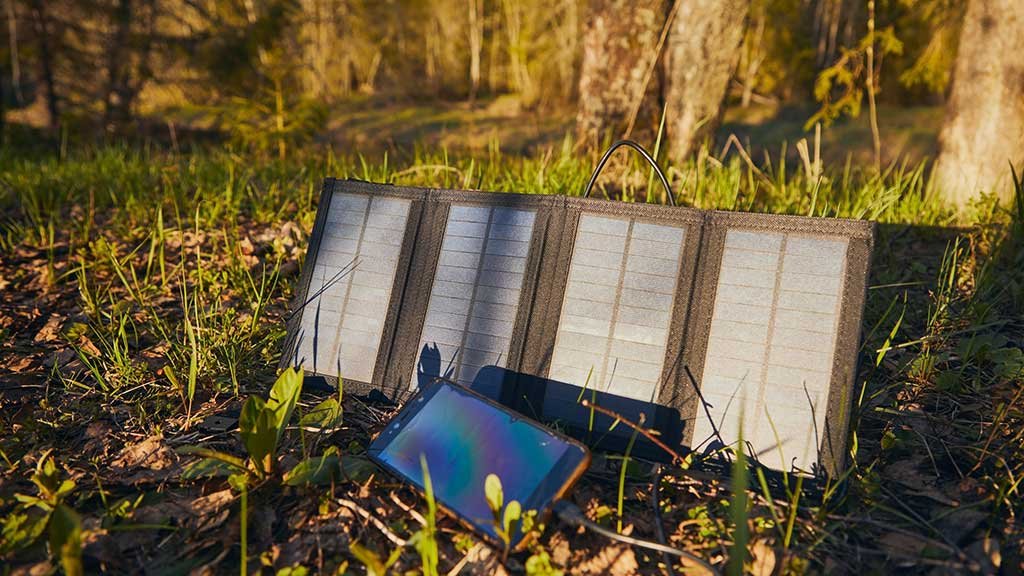
Planning rests on three figures: what your kit uses each day, how long it must last before a reliable recharge, and how much the panels can put back. One example runs through this guide: a two-night trip with a cool box, lights, phones, and a laptop.
Where Does a Solar Generator Fit Into Your Camping Plan?
A solar generator pairs a portable power station with solar panels. The panels produce electricity, the power station stores it, and its inverter converts it to AC for mains-style sockets. On a campsite, that suits lighting, device charging, and small appliances.
Solar Generator, Hook-Up and Fuel Generator: How They Compare
Hook-up is the most dependable source where a pitch has it, within its supply limit, though such pitches usually cost more. A fuel generator does not depend on sunshine but brings fuel, noise, and exhaust that many sites restrict. A power station with panels has no exhaust at the pitch, yet its output, stored energy and solar yield limit what it can run. A night on hook-up can also refill the battery for the nights that follow.
Check Campsite Rules and Your Pitch Before You Book
The Caravan and Motorhome Club’s generator advice says they should not be used on its sites between 6 pm and 9 am, while the Camping and Caravanning Club leaves running times to site teams and expects no noise from 11 pm to 7 am. Neither sets a separate rule for battery power stations, but quiet hours still cover a cooling fan. When booking, describe your kit and ask whether the pitch has hook-up and an unshaded spot for panels.
How Much Power Will You Need at Camp?
Watts and Watt-Hours: Check Both for Every Device
Watts (W) measure power and decide whether an output can run a device; watt-hours (Wh) measure energy, and runtime depends on how fast the device uses it. Check the combined running load against the station’s continuous output, start-up demand against its surge capability, and each connection against its port limit.
Kettles, Cooking and Heating: High Wattage, Limited Runtime
Most UK mains kettles are rated at 2,000 to 3,000 W, beyond a 1,500 W AC output. Heat also drains a battery fast: 2,000 W for six minutes uses about 200 Wh before losses, and an electric heater left on overnight would need several kilowatt-hours. A camping stove used outdoors keeps boiling and cooking off the battery.
Build a Daily Energy List for Your Trip
Count only what draws on the power station. A cool box running from the car’s 12 V socket while you drive stays out of the total.
| Device | Powered by | Assumed use | Daily Wh on the power station |
|---|---|---|---|
| Compressor cool box | Power station; car 12 V when driving | 24 hours at camp | 260 |
| LED lights | Power station | 10 W for 5 hours | 50 |
| Two phones | Power station | About 15 Wh each | 30 |
| Laptop | Power station | 40 W for 1.5 hours | 60 |
| Kettle and cooking | Camping stove | Not counted | 0 |
That makes about 400 Wh a day. For your own cool box, use its consumption data and duty cycle instead.
How Will You Recharge During the Trip?
Plan for the Time Between Reliable Recharges
Next, work out how long the kit must last before a recharge you can count on, such as a booked night on hook-up; sunshine depends on the weather and on the panels staying out. A positive total for the trip does not help if the battery runs flat on the first night and the sun returns only the next afternoon. The example assumes two days without useful charging.
Plan Solar Charging Around the Season, Weather and Pitch
Met Office UK averages for 1991 to 2020 record about 192 hours of sunshine in May and 43 in December. These are recorded sunshine hours, not the equivalent full-sun hours used to estimate panel output.
Panels still charge under cloud, only far more slowly, and trees or hedges cut the yield further. Open sky to the south helps, as does turning the panels towards the sun every few hours. Hours when the panels are packed away, for example while camp is empty, add nothing.
Electric Hook-Up and Car Charging
Hook-up is the fastest way to refill a power station, though not every pitch has it. Car charging is much slower: the Jackery Explorer 1000 v2 takes about 12 hours from a car socket, with the cable sold separately, so a short drive adds only a small part of a charge. It cannot take solar and car charging at the same time either.
What to Cut Back When Recharging Falls Short
When a grey spell arrives, keep lighting and phones going and trim the rest. In the example, leaving the laptop off saves 60 Wh a day. The cool box is the largest load, so packing it with food that is already cold and opening it less often shortens how long the compressor runs.
Which Solar Generator Setup Suits Your Trip?
Size the Battery for the Longest Gap Without Charging
A solar generator, for example, has to cover the two-day gap. With 85% efficiency from battery to devices and a 20% reserve (example assumptions, not model specifications), it needs 400 Wh × 2 ÷ (0.85 × 0.80) ≈ 1,180 Wh of rated capacity.
Match Solar Panel Output to Your Recharge Plan
Replacing a 400 Wh day means returning about 470 Wh to the battery. With 200 W of panels, an assumed three equivalent hours of full sun and a 0.75 loss factor, a bright summer day returns about 450 Wh, just short of that, and a dull day far less. In this example, the gap means trimming demand or adding another charge.
Compare Capacity Needs for Different Trips
Three trips, under the same assumptions:
| Trip | Daily use and gap | Rated capacity needed | Check next |
|---|---|---|---|
| Phones, lights and laptop | 140 Wh a day, 2 days | About 410 Wh | USB-C power for the laptop |
| Example, full daily recharge | 400 Wh a day, 1 day | About 590 Wh | Recharge amount and timing |
| Example, two grey days | 400 Wh a day, 2 days | About 1,180 Wh | Weight and space in the car |
The Jackery Explorer 1000 v2 (1,070 Wh, 1,500 W, 10.8 kg) exceeds the second row’s capacity; with two 100 W panels, it charges fully in about 7.5 hours of good sun. The Jackery Explorer 2000 v2 (2,042 Wh, 17.5 kg) meets the third row’s capacity.
FAQs About Camping With a Solar Generator
Can You Leave a Solar Generator Out in the Rain?
The Jackery SolarSaga 100W and 200W panels are rated IP68, but the power stations in this guide have no published IP rating and should not be treated as rainproof. Keep them under cover on a dry surface with the vents clear, since plastic wrapping traps heat, and keep connectors off wet ground.
Can a Power Station Run a Camping Fridge or Electric Cool Box?
Often, yes, if the output suits the appliance and the battery lasts until the next recharge. Compressor cool boxes cycle on and off, while thermoelectric ones usually run continuously, so daily use varies widely. Check the appliance’s connector, its energy use, and the limits of the matching output.
Can You Charge the Power Station While Using It?
Yes, the power stations in this guide support pass-through charging. The battery level rises only when the input exceeds what the devices draw, so on a dull afternoon with the cool box on, it can still fall.
How Should You Store Your Kit Between Trips?
The manual for your model sets the storage temperature and the charge level to leave in the battery. Check both before packing the kit away, and dry the panels and cables after a wet trip.
Final Thoughts
A solar generator suits a UK camping trip best when planned in order: list the devices and their daily use, decide how long the kit must last before a reliable recharge, then size the battery and panels for that gap. For a night of phone charging, a power bank is enough, and with hook-up most nights, a smaller power station may do.

