


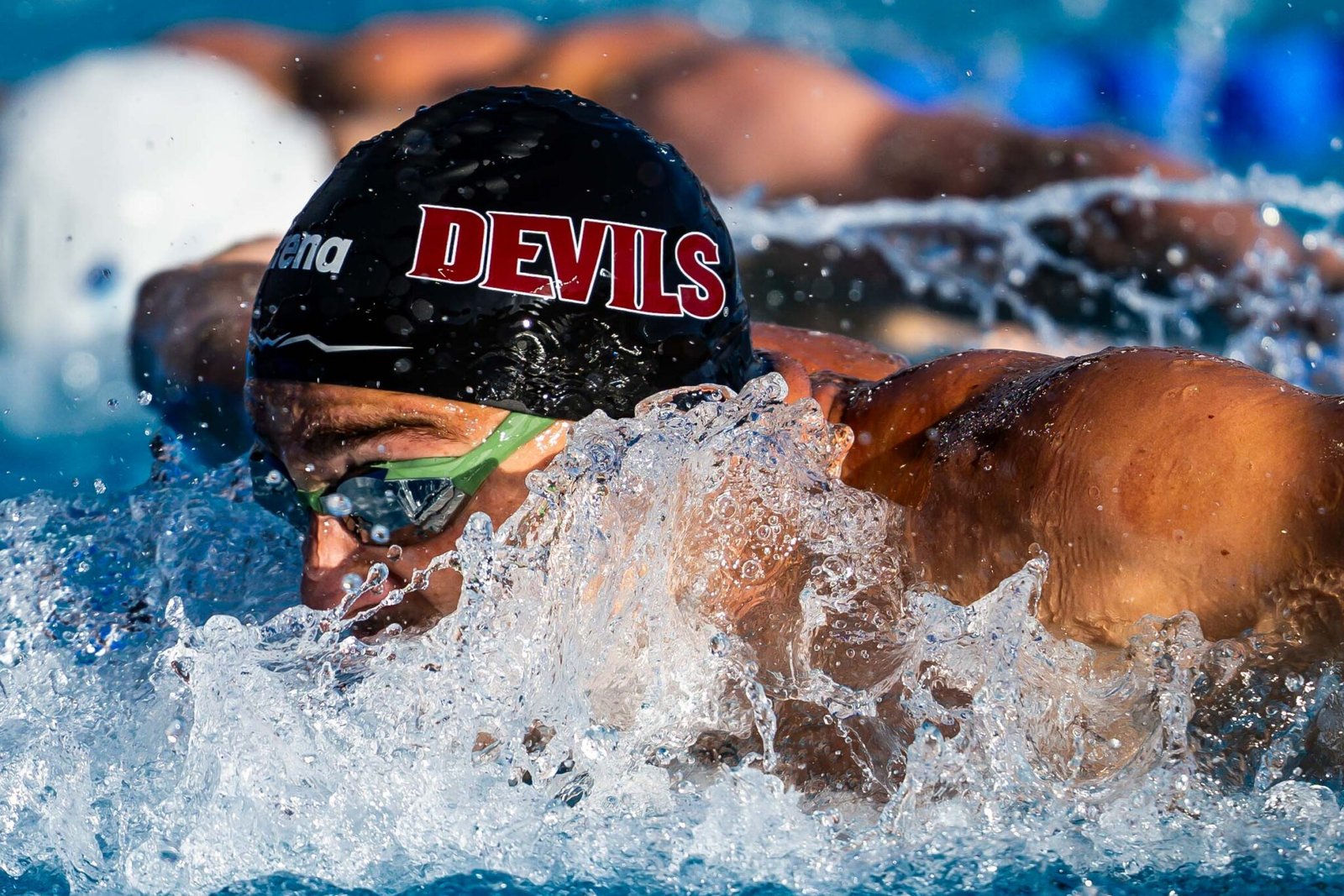
It’s that time of the year again. SwimSwam will be previewing the top 12 men’s and women’s teams (and then some) from the 2026 NCAA Championships. Follow along with the College Swimming Preview Channel. Want to read even more? Check out the latest edition of the SwimSwam magazine.
#4 Men: Arizona State Sun Devils
Key Losses: Remi Fabiani (37 NCAA points, 4 NCAA relays), Jonny Kulow (27 NCAA points, 4 NCAA relays), Adam Chaney (19.5 NCAA points, 4 NCAA relays), Andy Dobrzanski (1.5 NCAA Points, 2 NCAA relays), Tommy Palmer (Individual NCAA Qualifier), Jordan Tiffany (Individual NCAA Qualifier)
Key Additions: HM Jake Lloyd (OH – free/all-around sprinter), BOTR Tyler Porter (CA – sprint free/fly), BOTR London Rising (MI – free/fly), Nathan Muratory (France – back/free), Sergio de Celis (Spain – sprint free/fly), Kristupas Trepocka (Lithuania – free), Nick Simons (Tennessee transfer – back), Oliver Munn (Sweden – breast)
GRADING CRITERIA
Over the years, we’ve gone back and forth on how to project points, ranging from largely subjective rankings to more data-based grading criteria based on ‘projected returning points.’ We like being as objective as possible, but we’re going to stick with the approach we’ve adopted post-COVID. The “stars” will rely heavily on what swimmers actually did last year, but we’ll also give credit to returning swimmers or freshmen who have posted times that would have scored last year.
Since we only profile the top 12 teams in this format, our grades are designed with that range in mind. In the grand scheme of college swimming and compared to all other college programs, top 12 NCAA programs would pretty much all grade well across the board. But in the interest of making these previews informative, our grading scale is tough – designed to show the tiers between the good stroke groups, the great ones, and the 2015 Texas fly group types.
- 5 star (★★★★★) – a rare, elite NCAA group projected to score 25+ points per event
- 4 star (★★★★) – a very, very good NCAA group projected to score 15-24 points per event
- 3 star (★★★) – a good NCAA group projected to score 5-14 points per event
- 2 star (★★) – a solid NCAA group projected to score 1-4 points per event
- 1 star (★) – an NCAA group that is projected to score no points per event, though that doesn’t mean it’s without potential scorers – they’ll just need to leapfrog some swimmers ahead of them to do it
We’ll grade each event discipline: sprint free (which we define to include all the relay-distance freestyle events, so 50, 100 and 200), distance free, IM, breaststroke, backstroke, butterfly and diving. Use these grades as a jumping-off point for discussion, rather than a reason to be angry.
Also, keep in mind that we are publishing many of these previews before teams have posted finalized rosters. We’re making our assessments based on the best information we have available at the time of publication. Still, we reserve the right to make changes after publication based on any new information that may emerge regarding rosters. If that does happen, we’ll make certain to note the change.
The final note is that we are not including athletes who graduated last spring after exhausting their college eligibility despite ongoing lawsuits against the NCAA regarding the new “Five-for-Five” rule.
2025-26 Lookback
The Arizona State men got a massive boost from transfers last season, and they moved up to 4th at the 2026 NCAA Championships in their 2nd year under coach Herbie Behm after finishing 6th in 2025.
The Sun Devil men were led by junior Ilya Kharun, who scored 52 points after he finished 1st in the 200 fly, 3rd in the 100 fly, and 3rd in the 50 free.
Kharun was followed in the point rankings by two 5th years in Remi Fabiani (37 points) and Adam Chaney (19.5 points) and a senior, Jonny Kulow (27 points).
Sophomore Tolu Young brought in 9 points in the 50 freestyle and senior Andy Dobrzanski rounded out the points in the breaststroke events.
The Sun Devil men also broke two NCAA relay records during the 2026 season, the 200 and 400 freestyle relays.
Their 400 free relay record came at the Big 12 Championships, when they swam 2:42.15 to win the Big 12 title and take almost two tenths off the 2:42.30 mark set by Tennessee in 2025. At NCAAs, they won the event in 2:42.38.
They took down the 200 free relay record at NCAAs, swimming 1:12.46 to cut more than three tenths off Tennessee’s 2025 record of 1:12.80.
The Sun Devils also won the 200 medley relay at the 2026 NCAA Championships in 1:20.07, and they won the 400 medley relay in 2:56.79.
They finished 8th in the 800 free relay at 6:08.71.
Sprint Free: ★★★ ½
The ASU men’s team is very strong in the 50 freestyle, but they fall apart a little as the distance goes on.
In the 50 free, ASU will return senior Ilya Kharun. He finished 3rd in the event in 2026, stopping the clock in 18.24. He will be the highest returning swimmer for this year with Quintin McCarty coming in more than two tenths back in 18.47 as the next highest returner.
Junior Tolu Young also returns for the Sun Devils after he finished 9th in the event last year, swimming 18.76 at NCAAs.
Junior Quin Seider is another returning 50 freestyler, having finished 30th in 2026 with his 19.30 at NCAAs. His lifetime best is 19.22, which still sits outside scoring position.
The Sun Devils lost their only two point scorers in the 100 freestyle last season, Jonny Kulow and Remi Fabiani. Fabiani was also their only point scorer in the 200 freestyle.
Kharun will be their top returning 100 freestyler, but he likely won’t swim the event since it is the same day as the 200 fly, where he is the heavy favorite to win.
Quin Seider will be their next fastest returner at 41.69. This was about a tenth under cutline of 41.81 and is only a tenth off the 41.56 it took to score.
Seider is also their fastest returner in the 200 freestyle at 1:32.33. This was two tenths off the cutline of 1:32.13, but if he can improve his endurance in the event, he could earn an individual NCAA invite.
There are a few incoming freshmen with strong times, which could see them develop into NCAA qualifiers after a year with Behm. Honorable mention ranked recruit Jake Lloyd comes in at 19.3 in the 50 free and 43.4 in the 100 free and BOTR Tyler Porter sits at 19.4 in the 50 free and 43.3 in the 100 free.
Their top incoming sprinter is Spain’s Sergio de Celis. He will be a 5th year this season, making this his only year with the ASU team. His SCM best times in the 50 free and 100 free both convert to potential scoring range at 18.6 and 41.6. If he handles the transition well, he will help replace the sprinters ASU lost.
Distance Free: ★
ASU did not score any points in the distance free events at the 2026 NCAA Championships, and they are not projected to score any this season. Last season it took 4:13.85/14:52.80 to earn invites in the 500 free and 1650 free, and it took 4:12.75 to score in the 500 and 14:47.47 to score in the 1650.
Their top returning 500 freestyler is sophomore Noah Mudadu, who swam 4:15.51 at the Big 12 Championships to finish about half-a-second ahead of teammate Reece Grady’s 4:15.93. Grady will be a senior this year.
Mudadu will also be the top returning miler with the 15:02.39 he swam to finish 2nd at the Big 12 Championships. He was off his lifetime best of 14:53.49, which would have put him just a second off an invite. If he can get back to that time this year, he could be ASU’s only athlete in the distance races.
Backstroke:★★★★ ½
An incoming backstroke class will be a massive boost to a backstroke group that was massively depleted after the top four 100 backstrokers and top 200 backstroker graduated after last season.
Senior JT Ewing is the only returning NCAA backstroker on the team. He has a best time of 1:39.00 in the 200 back, and he finished 18th in the event at the 2026 NCAA Championships with his 1:39.50. If he matched his lifetime best, he would have finished 15th.
Freshman Nathan Muratory, the world junior record holder in the long course 200 backstroke, joins a long line of French athletes to swim at Arizona State with converted times of 44.30 and 1:35.89 in the 100 back and 200 back. His 100 back time would have been 8th at the 2026 NCAA Championships and his 200 back would have been 2nd, only behind Hubert Kos.
Tennessee transfer Nick Simons is joining the program after he qualified for the ‘A’ final in the 200 back last season after setting a lifetime best 1:38.21 in the prelims. His 100 back time sits at 44.93, which he swam to finish 18th at NCAAs, only two tenths out of the 44.78 it took to score.
Breaststroke: ★
Just like in the backstroke events, ASU’s top four 100 breaststrokers and top 200 breaststroker graduated after last season, leaving a pretty big hole in the program.
Brayden Taivassalo is the top returning breaststroker in each event. In the 100 breast, he was 5th in the 100 breast last season in 52.47 and 2nd in the 200 breast in 1:52.33. Both were off the NCAA cutline of 51.51/1:52.29.
Swedish freshman Oliver Munn appears to be the top breaststroker on the team this year with SCM times that convert to 52.8 in the 100 breast and 1:55.7 in the 200 breast. These are both still off the cutline, but Munn swam 53.02 in the 100 breast at ASU’s pentathlon last weekend, which points to the potential for a much faster swim than 52.8.
Butterfly: ★★★★
Ilya Kharun leads the men’s butterfly group as the reigning NCAA champion in the men’s 200 butterfly and the top returning swimmer in the 100 fly and the favorite to win both at NCAAs.
With Luca Urlando foregoing his final year of eligibility, Kharun is the heavy favorite to win the 200 fly title again. He swam 1:37.66 at NCAAs, a tenth off his best and the only time under 1:38 in the event.
In the 100 fly, Kharun finished 3rd behind Josh Liendo and Hubert Kos, who became the 1st and 2nd fastest performers in NCAA history. In the NCAA final Kharun swam 42.92 to become the 4th person in history under 43 seconds and the 4th fastest performer ever. He will be the heavy favorite to win the 100 fly title as well.
While Kharun is projected to win both butterfly events, he is ASU’s only projected qualifier in either butterfly event, and our star rankings say “a very, very good NCAA group projected to score 15-24 points per event”. An NCAA title is only worth 20 points.
Senior Filip Senc-Samardzic is the next fastest returning butterfly at 44.95 in the 100 fly and 1:41.75 in the 200 fly. His 100 fly time was only four hundredths off the 44.91 cutline in the event. If he can drop a little in the event, he could earn an NCAA invite in the event.
IM: ★★
ASU had no individual point scorers in the IM events in 2026, but Michael Hochwalt will return as a junior after he finished 19th in the event (3:40.85) last season.
Hochwalt had a huge swim in the 400 IM ‘B’ final at the Big 12 Championships after he struggled in prelims to finish 10th overall. In finals, he swam 3:40.02, which would have won the event by more than four seconds in the ‘A’ final. He earned an individual invite to NCAAs, where he finished 19th, but his lifetime best would have been 15th overall.
JT Ewing is the top returner in the 200 IM, and with no 200 backstroke conflict this year, he is another potential NCAA qualifier. His lifetime best is 1:42.93, which would have been just over two tenths off the NCAA cutline of 1:42.69.
There are a host of freshmen who could develop this year, but nobody else is coming in with potential NCAA qualifying times currently.
Diving: ★
The Sun Devils did not score any points at the 2026 NCAA Championships. They do not have any scoring divers coming in, but they did pick up Mario Del Valle from Cal Baptist, who finished 25th on the 1-meter event at last season’s NCAAs.
Relays: ★★★★★
Note that the grading system doesn’t align perfectly for relays as double points.
Relay grading system:
- 5 star (★★★★★) – 31+ points per relay event
- 4 star (★★★★) – 22-30 relay points per event
- 3 star (★★★) – 12-21 relay points per event
- 2 star (★★) – 5-11 relay points per event
- 1 star (★) – 0-4 relay points per event
| Relay | 2026 NCAA Result (Time) | Lineup | Losing | Potential Adds | |
| 200 FR | 1st (1:12.46) *NCAA Record | Remi Fabiani, Adam Chaney, Ilya Kharun, Jonny Kulow | Remi Fabiani, Adam Chaney, Jonny Kulow | Tolu Young, Quin Seider, Sergio de Celis | 1:12.46 |
| 400 FR | 1st (2:42.38) | Ilya Kharun, Adam Chaney, Remi Fabiani, Jonny Kulow | Adam Chaney, Remi Fabiani, Jonny Kulow | Tolu Young, Quin Seider, Sergio de Celis | |
| 800 FR | 8th (6:08.71) | Remi Fabiani, Filip Senc-Samardzic, Mattia Mauri, Jonny Kulow | Remi Fabiani, Jonny Kulow | Tolu Young, Quin Seider, Sergio de Celis, Kristupas Trepocka | 6:08.31 |
| 200 MR | 1st (1:20.07) | Adam Chaney, Andy Dobrzanski, Ilya Kharun, Jonny Kulow | Adam Chaney, Andy Dobrzanski, Jonny Kulow | Nathan Muratory, Oliver Munn, Tolu Young, Quin Seider, Sergio de Celis | 1:20.07 |
| 400 MR | 1st (2:56.79) | Adam Chaney, Andy Dobrzanski, Ilya Kharun, Remi Fabiani | Adam Chaney, Andy Dobrzanski, Remi Fabiani | Nathan Muratory, Oliver Munn, Tolu Young, Quin Seider, Sergio de Celis | 2:56.79 |
The Sun Devil relays did exceptionally well last year, but each of their five relays graduated at least half of the members, with all four of their winning relays graduating three of the four.
They still appear to be in a strong position this year, particularly in the medley relays with the addition of Muratory.
With so many of their athletes graduating, it is difficult to predict how the relays will perform and who will be used to substitute where, but it seems likely that they will still have multiple sub-19 50 freestyles this year.
Total Stars: 22/40
2026-27 Outlook
This ASU team has some massive potential, and the favorites to win multiple different events this season. Ilya Kharun will be a huge player on the team this year, and he could help pull the team to some massive swims particularly on relays.
There are places where the Sun Devil team is weak, particularly in the distance freestyle events, but a lot of the spots where they are short stars could easily become point scoring events with the international students they brought in.
ASU has shown over the last few years that they can develop swimmers, particularly sprinters into what they need, and as long as they continue to follow that trend, they should finish in the top-10 again this year.
The relays are a huge potential point scoring spot for ASU, and it would not be surprising to see them win multiple relays again this year, though they will likely be much closer than they were last season.
Men’s 2026-27 College Preview Index
| Rank (2026) | Team | Sprint Free | Distance Free | Backstroke | Breaststroke | Butterfly | IM | Diving | Relays | Total Stars |
| 1 | ||||||||||
| 2 | Florida Gators | |||||||||
| 3 | ||||||||||
| 4 | ★★★½ | ★ | ★★★★½ | ★ | ★★★★ | ★★ | ★ | ★★★★★ | 22/40 | |
| 5 | ★★★★★ | ★★½ | ★★½ | ★★★ | ★★★ | ★ | ★★★★ | ★★★★½ | 25.5/40 | |
| 6 | NC State Wolfpack | ★★★★½ | ★★★½ | ★★★ | ★ | ★ | ★★★ | ★ | ★★★★★ | 22/40 |
| 7 | California Golden Bears | ★★ | ★★★½ | ★★★½ | ★★★★ | ★★½ | ★★★½ | ★ | ★★★ | 23/40 |
| 8 | Michigan Wolverines | ★ | ★★ | ★ | ★ | ★★★ | ★★★★ | ★★ | ★★ | 16/40 |
| 9 | Virginia Cavaliers | ★★½ | ★ | ★★★ | ★ | ★★★★ | ★★★★ | ★ | ★★★½ | 19/40 |
| 10 | Stanford Cardinal | ★★★½ | ★★★ | ★★ | ★★½ | ★★ | ★ | ★★★ | ★★½ | 19.5/40 |
| 11 | Virginia Tech Hokies | ★★★ | ★ | ★★ | ★★ | ★ | ★ | ★ | ★★ | 13/40 |
| 12 | Louisville Cardinals | ★★★ | ★ | ★ | ★★ | ★★ | ★★ | ★★ | ★★★ | 16/40 |

