


By the late 1950s, the Space Race was dominating the Cold War, the United States military was rapidly testing advanced fighter jets and looking at how it could build out its rocket arsenal both for offensive use and to send Americans into space. And then they hit a snag.
The U.S. military had so rapidly built out its new aircraft that it had a new problem. Jets, like the X-15, could hit the upper atmosphere and break the sound barrier. However high altitude and high speeds meant that bailing out of these aircraft was riskier than ever. Beyond their rapid speed, pilots would have to deal with limited oxygen, extreme cold and the risk of spinning out at terminal velocity. To deal with this, as the National Museum of the United States Air Force said, “the USAF developed new multi-stage parachutes — with small, medium, then large parachutes deploying as the pilot fell — that allowed safe descent from incredible heights.”
Top Stories This Week
It led to Project Excelsior, where the United States Air Force would intentionally send an airman into the stratosphere to then jump back to Earth, in the hopes of perfecting parachute technology. The project kicked off in 1958. It was meant to help both regular aircraft operations and provide safety data for the emerging crewed space program.
The U.S. military had a long history with trying to reach the stratosphere. For several decades in the 20th Century, military personnel used balloons to push altitude records. When the Space Race fully kicked off in the 1950s, it became a race between the Americans and Soviets using revolutionary rocket technology. But that didn’t mean the end of the use of balloons. They would continue to be used for testing, such as in Project Excelsior.
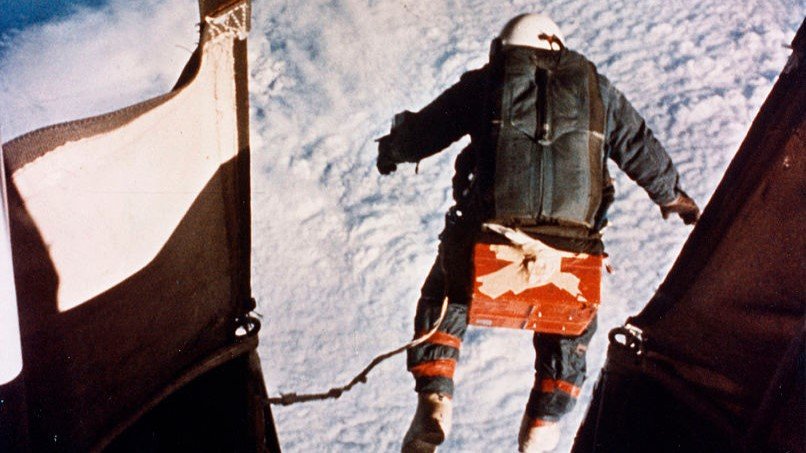
Air Force scientists designed a multi-stage parachute, and soon the service needed to test it. Crews designed a gondola that would, using a helium balloon, carry a person miles up into the stratosphere to then jump and deploy the parachute system. Enter Air Force Capt. Joseph Kittinger, who took part in one of the wildest scientific experiments of all time.
Over the course of 10 months, Kittinger went to the stratosphere, jumping back to Earth three times. He wore a specialized pressure suit, meant to survive the lack of atmosphere. The suit was very much a rudimentary 1950s design; photos of the jumps show a tool box strapped to the back of it for instance. The first two trips took him between 74,000-77,000 feet in the air in late 1959. He would free fall back to Earth, enduring heavy spins, chutes that failed and other issues. And then nearly a year later, he made a jump that would set a decades-long record.
The third and final test happened on Aug. 16, 1960. For this final jump, Kittinger went nearly 20 miles up. There were already problems. The pressure suit had a minor flaw; one glove hadn’t pressurized, leaving one hand swelling from low atmosphere and leaving Kittinger unable to pull at his ripcord. Kittinger took the balloon up to a record 102,800 feet above Earth and despite the challenges, he jumped off of the gondola. Kittinger reached a top speed of 625.5 miles per hour, falling for more than four minutes. The parachute deployed and worked as intended, safely slowing him and helping him return to Earth.
The 1960 effort would earn the Air Force officer a Distinguished Flying Cross, his second. Kittinger “made an open gondola balloon ascent to an altitude of 102,800 feet, surpassing all previous records,” his citation noted.
“From this record altitude, Captain Kittinger successfully tested an experimental stabilization parachute system, free-falling for four minutes and thirty-eight seconds to an altitude of 17,500 feet where deployment of the recovery parachute occurred,” it continued. “By this historic achievement of national and international significance, Captain Kittinger has made a vital contribution to the advancement of aeronautical science. The personal courage, outstanding airmanship and selfless devotion to duty of Captain Kittinger reflect great credit upon himself and the United States Air Force.”
Kittinger would later serve in several combat tours in Vietnam, eventually being shot down in 1972 and spending 11 months as a prisoner of war before being released. He would earn four more Distinguished Flying Crosses during the war.
If Project Excelsior seems like something more out of the X Games, or something that would be sponsored by Red Bull, well, Red Bull would sponsor a similar exercise more than 50 years later. In 2012, Felix Baumgartner would break Kittinger’s record, with the Air Force veteran serving as part of his crew.
Still, Project Excelsior ended up being an important series of experiments. The tests not only helped bailout preparations for jet pilots, it also contributed to safety measures for the American space program. And it set a record that would last more than five decades.
Task & Purpose Video

