


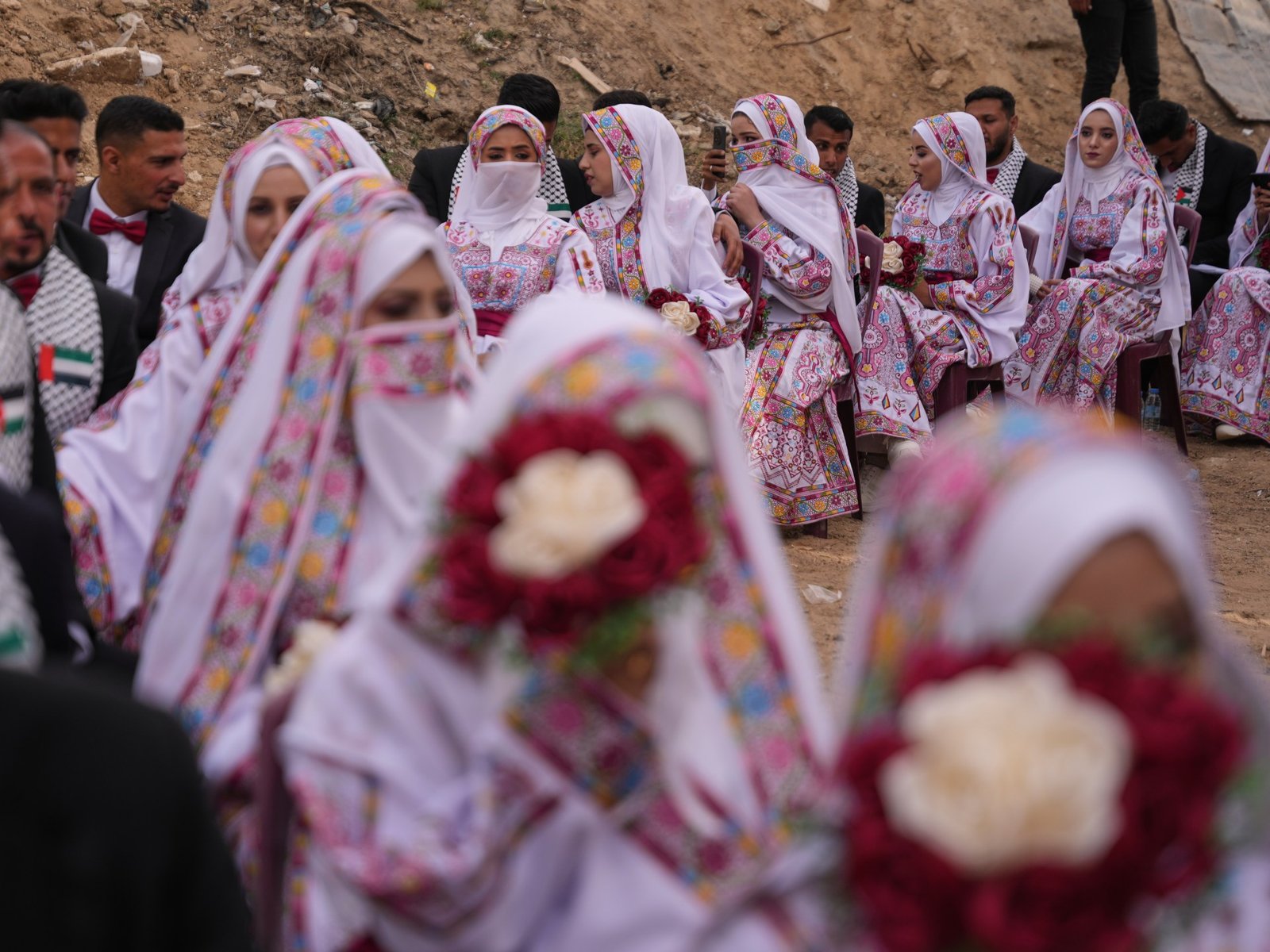
Empty venues
Flower availability has also changed. A bouquet may seem like a small and easily accessible part of a wedding, but in Gaza, even acquiring flowers can be difficult.
Fresh flowers are rare finds, and the price of artificial flowers has risen sharply amid the shortage. It’s so expensive now, in fact, that many brides resort to borrowing or renting artificial bouquets — just to hold them for a few hours.
There’s also a shortage of wedding halls. Before the war, these venues provided large spaces for families and friends to decorate, fill with music and celebrate.
But the war destroyed many of the halls, and some that remain are in areas people are not allowed to enter. For example, Mazaya Hall, once a very popular venue, is now located in the Yellow Zone, the contentious military border set up as part of the US-brokered ceasefire.
Other halls have reopened despite severe war damage, and some have used nylon sheets and fabric to repair the damaged spaces.
Hani Reihan, manager of al-Reihan Hall, located in the northern part of the Gaza Strip, says he opened his venue earlier this year because of the shortage of wedding halls.
“My wife’s brother was getting married, and he rented a cafe for two days for 3,900 shekels ($1,300),” he said.
That amount was the average annual per capita income across Gaza in 2022; by late last year, the average had dropped by at least 85 percent to about 500 shekels. So Hani’s family paid a lot for the venue.
“The first day was for the men,” he said. “On the wedding day, the bride put on her white dress, but there was a problem with the equipment, and the DJ did not work.”
So the bride got married but could not have a celebration.
Hoping to cash in on a gap in the market and to provide families with a decent venue, Hani bought an old pickle warehouse and transformed it into al-Reihan Hall.
“I wanted to stand with people and give them a chance to celebrate,” he said.
Halls like this are hard to maintain.
Mousa Nabhan, who works at al-Tayeb Hall, a well-known wedding venue in the Jabalia area of the northern Gaza Strip, refers to the high costs of every input of the business.
“The cost of electricity and running the hall is very high,” he said. “Even decorations and flowers are expensive. A single artificial flower costs 25 shekels ($8). We get only five weddings a month, sometimes even fewer.”
For some halls, however, the challenge goes beyond war damage and operational costs; it is also about who is left to celebrate.
At al-Wurood Hall, a large venue in the Jimmizat Abu Ghneima area of the northern Gaza Strip, for example, manager Abu Warda says he is often surprised by how few family members are involved in the wedding celebrations.
“Several grooms come to book the hall and give me a paper listing the different parts of the wedding. I look at it, but sometimes I don’t see any parts for the groom’s family. I ask, ‘Where is your family?’ and he tells me, ‘They were all killed. I am the only one left, but I want to make the bride and her family happy.’”
The location of these halls reflects the shrinking space available for life in Gaza. Most of the halls are close to the “Yellow Line”, and the reason is simple: 70 percent of Gaza is under occupation and siege, so there are not enough places left to operate.
“We are taking a risk with this project and expect that Israeli forces could enter the area at any moment,” says Warda, noting how close his hall is to the “Yellow Line”.
With fewer available halls and rising costs, some couples have had to find other places to celebrate. As a result, some couples now hold their weddings in tents or empty spaces because wedding venues are too expensive.

