


Jon Wiener: From The Nation magazine, this is Start Making Sense. I’m Jon Wiener. Later in the hour: Elon Musk calls Christopher Nolan’s film “The Odyssey” “part of a left-wing plan” to “destroy Western Civilization.” John Powers has a different view – he’s critic-at-large on NPR’s “Fresh Air” with Terry Gross. But first: election protection – Skye Perriman will comment – in a minute.
[BREAK]
We have less than 100 days to the midterms, where Trump has various plans to undermine Democratic voting. To talk about election protection, we turn to Skye Perryman. She’s president and CEO of Democracy Forward, a leading election protection legal group. After starting out at Midway High School in Waco, Texas, now we read about her work in The New York Times and The Washington Post. We see her frequently on MSNBC and CNN. The news last week was that she had met with Chuck Schumer and other legal experts who were members of the Senate Democrats’ Election Protection Task Force. Skye Perryman, welcome to the program.
Skye Perryman: Great to be with you.
JW: Let’s start with that Senate task force. Who else is on it? What did you do at your meeting with Schumer last week?
SP: This is a task force that’s comprised of a range of members of the Senate, as well as election protection experts and lawyers and senior government officials, nonprofit and nonpartisan leaders, lawyers who have spent their careers defending the right to vote. People like Marc Elias are in the room to make sure that people in this country are going to be able to vote and that their votes are counted, because unlike in prior elections, right now, our federal government, our executive branch, our president and his allies are actively working to undermine the ability of people to vote.
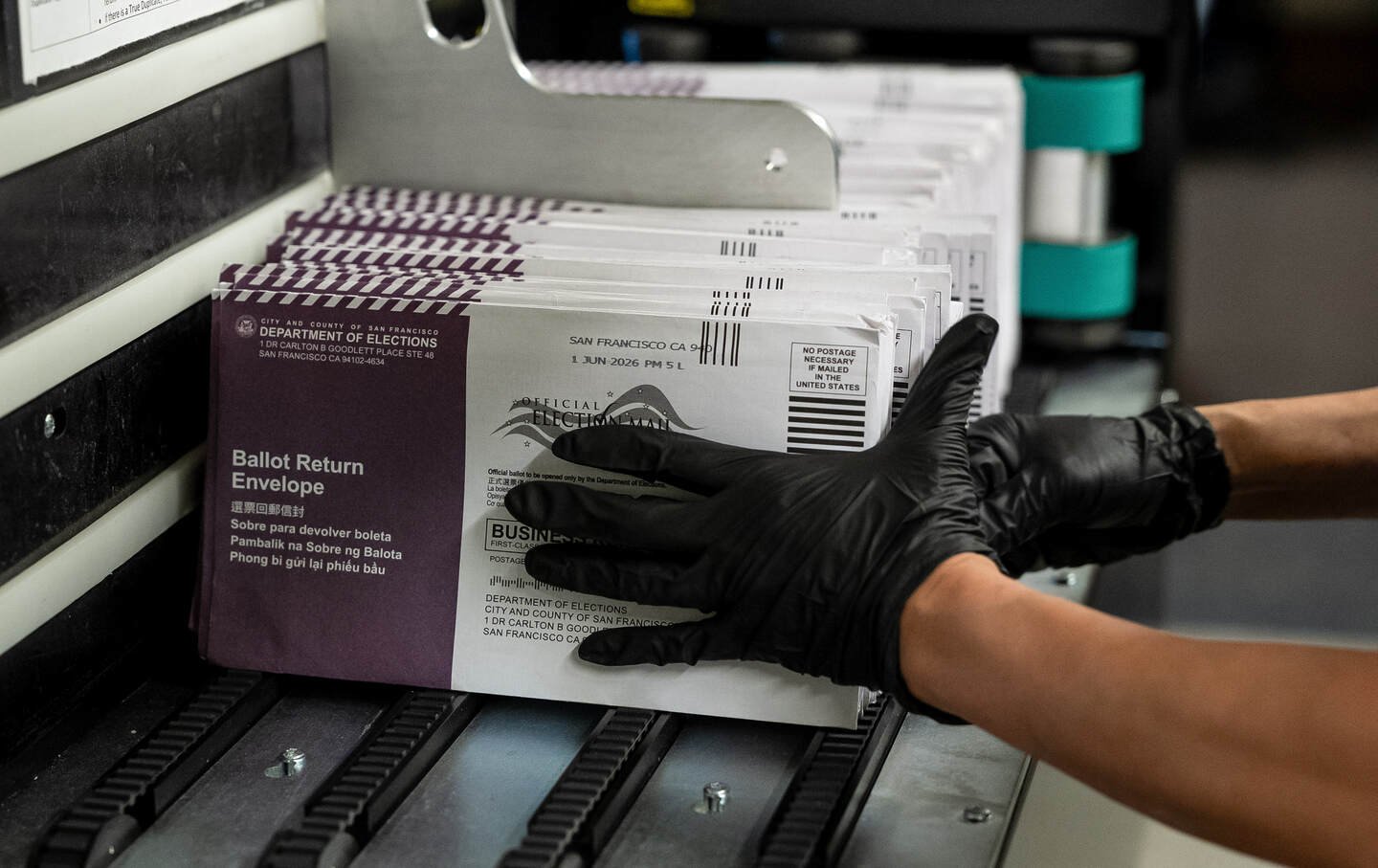
JW: Trump, of course, has been working hard at attacking Democratic voting. And just to review his record here, he’s had only one really big victory. And that was when the Supreme Court justices he nominated eviscerated the Voting Rights Act, which led to the creation of more Republican House districts. But aside from that, Trump has been mostly failing, mostly losing. The courts have blocked his efforts to enlist the Postal Service in undermining voting by mail. That was an appeals court ruling just last Friday. The courts have also blocked his efforts to force states to hand over their voter rolls so that he can check them. He’s lost all 17 voter roll cases decided by district courts. No judge has ordered a state to provide an unredacted voter list to Trump and his people. And of course, he’s failed in his efforts to get the Senate to pass his SAVE Act, you know, restricting voting by imposing I.D. requirements. So, what do you think his next move will be after this string of losses? What are his next moves that are the most threatening for some of our friends? They think he’ll declare a national emergency as a basis for sending ICE agents, or maybe the military to blue polling places on Election Day to intimidate voters there under the pretext of preventing fraud. I imagine you and your group have thought about that one.
SP: We have. I mean, let me just start by saying you’re absolutely right that the administration continues to lose across the board, in the courts and even this US Supreme Court. You saw Amy Coney Barrett in a decision this last term being very clear that the United States Constitution does not provide a role for the president in our elections. So that’s the background on which all of this is happening. So, we believe he could try to do a variety of things. Many people are worried about a national emergency. The thing I will say about that is that the president would have to have a lawful basis for declaring one, and this is an administration that has made a range of announcements that have been blocked by the courts, because often they’re arbitrary. The president would have to carry out his plans through federal agencies. Those federal agencies are losing in court. They’re held accountable through our civil system. And so that’s not to – we don’t want everyone to be naive here or be particularly relaxed. But we do need to focus on people voting, making sure they’re registering to vote, making a plan to vote and understanding that the lawyers will be able to bring cases against these things. You mentioned the military, and I want to be very clear that federal law spells out and could not be more clear that the military cannot be engaged in and around polling places or in elections. There is an express federal law against that. There is an express federal law that criminalizes any federal officer that tries to intimidate people with respect to voting, which could become very which could become very relevant with respect to ICE. So, that is not to provide people cold comfort, but it is to provide everyone the facts to understand that I believe this president will continue to hit obstacles if he tries to use the executive branch in that way.
JW: Another possibility our friends worry about is the day after Republicans lose the election, Trump will claim fraud and then would call on MAGA groups to stage big protests in front of state capitals in swing states to stop the certification of test results, sort of a mini January 6th in various states. What do you think about that?
SP: I mean, the one thing I’ll say is that the president’s voter suppression agenda is deeply unpopular with the vast majority of the American people, including people that may not support progressive or Democratic causes. And so, I think it’s important that we not give the president more power in our minds than he really has. This is a fringe type of movement that he is seeking to aid and abet and strengthen. But this is a deeply unpopular movement in a world where people were really seeking to deprive the American people of their choice through staging these types of protests through trying to endanger certification. I think that you have to look at what happened with his off-cycle redistricting. It turns out that two can tango. And so, if that is the type of thing that MAGA groups might do in red states, I think you could expect that there wouldn’t be a reason for blue states to certify any Republican that won. If this is, in fact, the kind of fire that the president wants to play with there. I don’t have inside knowledge on that. But that is my suspicion. And that is what we have seen happen with respect to off cycle redistricting. He tried to do this complete off cycle redistricting, and you saw blue states say, well, we can do that too. And the United States Supreme Court, by the way, did not intervene to stop California’s new map. And so, I do think that this is something that’s quite messy for the president. If he tries to engage like this.
JW: The biggest danger is probably in the blue cities, in the red states, where Republican governors and Republican state attorneys general will cooperate with whatever Trump wants to do to reduce Democratic voting. For example, your home state of Texas, the governors, Greg Abbott, the state attorney general, Ken Paxton. But this is a place where Kamala Harris got 800,000 votes in 2024 in Dallas, 500,000 votes in Houston, 400,000 votes in Austin. There’s a lot of Democratic votes in Texas. But the Republican governor and the Republican state attorney general, I doubt they’re going to be like Brad Raffensperger in Georgia defying Trump in 2020. What do you say to that?
SP: First of all, I think we do have to see how this plays out. I mean, you’ve already seen the secretary of state in Texas raise deep concerns about the accuracy of the information that’s coming from the federal government. And that is not a person that is aligned with Democratic or progressive causes.
But the other thing that’s important for people to understand is that the state and local governments do have a lot of authority. And you have in Texas, strong places like Harris County, which is where Houston, Texas, is, that are led by people that want to make sure that their citizens are able to vote, and they’re not going to stand idly by while the president or the governor or anyone else tries to undermine those votes so that that type of action could look like legal action, depending on what happens and depending on what mechanisms are used, it could look like blue states across the country also saying look, if this is how red state governors are going to act about blue cities, we can act that way about red cities. You have that in California. You have a number of places in California that are more red than blue, even though California is known as a blue state. Same with New York.
So again, I think that this is going to require a multi-pronged effort for all people, first of all, to make sure they’re voting, make sure they’re registered to vote and to vote, and to turn out for the lawyers to be ready to bring the action that needs to happen. And for political actors, for people that hold these positions, to not give in to a voter suppression agenda, that may mean doing what happened in Georgia, where Republicans did defy the president, but it also may mean blue states having to step up and say, “we’re not going to allow the red states to try to cheat the American people out of an election.” We have some power here, too, and I think you’ll see all of that. And I think we have seen all of that over the course of the last year, I think off cycle. The redistricting remains a really good example.
JW: Of course, there are a lot of groups working on election protection. In many ways, the lead over the past year has been taken by the blue state attorneys general, led by, you know, Tish James in New York, Rob Bonta in California. They sued Trump every week, and they’ve been planning this since before he was elected. And of course, there’s the ACLU, the Brennan Center, the Legal Defense Fund of the NAACP. They’ve been planning election defense since Trump was elected. And then there’s the organizations whose leaders work with you on that Senate task force. You mentioned Marc Elias of Democracy docket. There’s also Vanita Gupta of NYU, Ian Basson, Protect Democracy, Norm Eisen of Democracy Defenders. How does your group, how does the Senate task force, coordinate this big array of very talented groups of very talented people?
SP: There’s a range of coordination. There’s a range of wonderful task force. It’s wonderful that the Senate task Force has gotten some attention publicly. There’s also been public reports, and we’ve been engaged with the House of Representatives that have been running scenarios. There are a number of election protection tables and organizations. So, people are in really close contact. This is a multi-pronged effort because you have threats to our elections that are coming in an unprecedented fashion from our president. And there’s a playbook that has to be run to defend against those threats. You also have threats that have always existed in American society. People across the country, in some of these areas that do not want individuals to be able to vote, that want to try to intimidate. There have been voter protection hotlines run by civil rights and pro voting organizations for years. And so those organizations are, of course, strengthening their efforts. And don’t forget that there’s also the candidates. We don’t do a lot of candidate work at Democracy Forward because we’re nonpartisan and we are just, we’re about everybody voting. But when you look at someone like a Marc Elias, I mean, he typically represents a lot of candidates who if someone is going to mess with their election results they’re going to be lawyered up and they’re going to bring cases against that as well. And so, the candidates and the parties are another piece of this, even if they have to exist in a separate sort of orbit or ecosystem, then the pro voting and nonprofit organization groups. So, this has been an incredibly coordinated effort so far. You’ve seen an incredible amount of coordination that a Democracy Forward, we’ve been able to drive against the Trump administration’s other actions across the board. And I think you’re going to see the lawyers be very coordinated this time as well.
JW: I want to ask specifically about Democracy Forward your group. RFK Jr. coauthored an op ed in The Wall Street Journal recently complaining about you. He said that in 2025, your organization filed more than 150 lawsuits and took more than 400 legal actions against the Trump administration and launched more than 250 public records investigations. Is there any truth to these charges?
SP: Yes. I mean, look, we are proud of that record. We’re disappointed that this moment of history requires that amount of litigation against the federal government, which is a government that is supposed to be serving the people. And so, we’re very disappointed. Any time we have to sue a federal or state or local government, that for us, that means that there are people in communities across this country that are being failed by their government and that have to take legal action. So, in that way, it is disappointing. But we do assure, we said this right out back in our response to The Wall Street Journal, we are very proud of our record to represent people and communities in the court. And that particular op ed, he was complaining about litigation that our organization is maintaining on behalf of cities and nonprofit organizations to defend the Affordable Care Act and health care for over 2.2 million people in the country. Right after he came out with his op ed, we won a big court order stopping the administration from undermining the ACA. He was trying to pretend as if somehow the administration was protecting the ACA. I mean, it was just a bit bonkers. So, we’re very proud of that record and stand by those numbers.
JW: You’ve launched a project called “100 Days of Action” for the rest of between now and Election Day. Tell us about that.
SP: So, this is really the most important thing I think, that people and communities can do before Election Day. There is the doom scrolling. There is thinking about all the different ways the election could be rigged, or that the president could try to overtake the election. And people in communities have to know that the lawyers are going to be there. The president is going to continue to lose in court, and that we are all going to have to band together to make sure that our elections do occur, and that people are able to vote and that their votes are counted. The most important thing, however, is not to get all drawn up into every way the election could go wrong, or to wonder about what type of legal action the lawyers are to file. Guess what? We’re all going to file them there. It’s to make sure that we all, as individuals are doing our part to make our voices heard in this election. And so, what that looks like is taking individual actions that are in many instances, are very simple to take that do not take much time between now and the election. And so, we are encouraging people this week as part of the action plan to go check your voter registration. You can do it online. You can get some information, make sure you’re registered to vote. Talk to your community. We want to make sure people are also being informed. And so, we have some great short, not long, but great reading material about how we got into this and what do people need to understand? Our communities are really important. Democracy is a kitchen table issue. And so, the “100 Days of Action” plan will include ways to take small steps within our individual communities to make sure that we’re strengthening our bonds, because this is a time when all Americans are having to come together in new ways. And we’ve seen that over the past year, but we’re really pleased to be able to help folks that we hear from every day who are saying, what can I do in this moment to really be able to help folks engage?
JW: And one last thing. Apparently, the 400 legal actions you’ve taken against the Trump administration last year didn’t keep you busy because you also wrote a book. It’s being published August 25th. It’s called Ordinary People Extraordinary Times. How to reclaim your power, fight for freedom and reimagine democracy. A guide for all of us. Briefly tell us what we’re going to find in this book when it’s published.
SP: I hope you find everything you need about how to plug in and engage in this time, at a time where history is going to look back. Our kids are going to look back and ask, what did those people do at a time when democracy, when the very existence of our communities, were under attack, how did we come together and not just defend, not just try to restore old systems, but to reimagine and create something that truly serves everyone? So, this is a book that comes out in paperback. It’s available in audiobook, very accessible. The proceeds from the book go to benefit the work of Democracy Forward. There are seven action steps, checklist tip sheets, very accessible, a website you can go to get more information. And it’s all about how people – what people can do in this time. I draw from the amazing stories of the cases that we have built on behalf of people and communities, the bravery we’ve seen in communities from ordinary people, as well as what our history has taught us about the role of ordinary people. People forget change in this country has never come from the top. It’s always come from the people, the people demanding more. And that’s the kind of demand that people need to make in this time. And we’ve all got to get to work.
JW: You’ve said many times that in November we are going to have free and fair elections. How come you’re so confident about that?
SP: I’m confident in the American people. I’m confident in the American people’s lawyers, and I’m confident in the way this country has found its way forward over the past year. At a time when hope is really hard to find, when fear simmers everywhere. We have seen people in communities come together in truly extraordinary ways. Hundreds of millions of people are disapproving of what’s happening in this country. We’ve seen millions of people on the streets in the No Kings protest and demonstrations. These are the largest, the largest single day, peaceful mobilizations of people in U.S. history. More people in this country have been trained in nonviolent, nonviolent, direct, collective action in this time than ever were trained even in the civil rights movement and the courts. Even with the Supreme Court, the courts have been serving as a guardrail as well. And so, all of those things together make me know that we are going to have free and fair elections, but we’re not going to have them automatically. We’re going to have them because of the actions and the work that individual people have to take every day. And that’s why we’re so excited to have this “100 Days of Action.” I’m excited to be talking to you. The book comes out to help people figure out how to engage, but we’re going to be able to do it.
JW: Skye Perryman of Democracy Forward. Her book, coming out in August, is Ordinary People, Extraordinary Times. Skye, thanks for all your work and thanks for talking with us today.
SP: Thank you.
[BREAK]
JW: The big movie this week–this month–this season–is Christopher Nolan’s Odyssey. Elon Musk’s view is that the film is “part of a left wing plan” to “destroy Western civilization”– This is a quote—“and everything that helped create it.” For our analysis, we turn to John Powers. He’s critic at large for Fresh Air with Terry Gross, where he has an audience of millions. John Powers, welcome back.
JP: I’m glad to be here, Jon.
JW: I understand you saw The Odyssey the way Christopher Nolan intended — in real IMAX, on a screen, 101 feet wide, 75 feet tall, and, of course, three hours long, bigger than anything previously known to moviegoers. What did you think? Was Elon Musk onto something when he said that Christopher Nolan’s Odyssey was “part of a left wing plan” to “destroy Western civilization”?
JP: Well, that’s probably extreme, but I actually know what he’s saying. The complaint is that it’s a woke version of the Odyssey. And there’s kind of the dumb version of that, which is to look at a couple of the casting choices, like Lupita Nyong’o, and say, “but she was supposed to be white”–when, of course, the problem with casting Helen of Troy always is that she’s never beautiful enough. Charlize Theron in the film is an exceedingly beautiful woman, but if you made her Helen of Troy, she’s not beautiful enough. But by putting an African, a black African actress, in the role, what you do is you make her different and exotic enough that you can believe the people there all think she’s the most beautiful person in the world. Perfectly reasonable casting, not some sort of woke nonsense.
The part that’s true, I guess, in what he’s saying–not that it’s destroying Western civilization–is that the Odyssey had Greek values about winning and losing in conquest and slaves and kings–all the sorts of things that one can imagine Elon Musk liking, because no doubt he, in some sad yet grandiose way, fancies himself a kind of Odysseus, which is the person who’s much smarter and deserves to rule because he’s so much cleverer.
And here the Odysseus, played by Matt Damon, is kind of doleful and regretful of the things he’s done in order to win, feeling that he’s destroying civilization. So if you’re Musk, you’re thinking that this version is kind of the anti-Trump version, which is it’s not about winning. It’s about feeling bad even though you won.
JW: Yeah. The way Maureen Dowd put that was “he’s an action hero who feels bad about being an action hero.” And it’s striking that Christopher Nolan has pretty much the same character in most of his movies. Oppenheimer, the last one, invented the bomb to bring an immediate end to a war that had lasted way too long, and then he himself suffered psychologically afterward when he realized the damage the bomb had done to ordinary Japanese women and children. And Christopher Nolan’s Odysseus invents the Trojan horse to end a war that had lasted way too long, but then he himself suffered psychologically when he realized the damage it had done to the women and children of Troy — who were, of course, raped and murdered by his own men. So Christopher Nolan gives us two guys suffering from a kind of PTSD, 3000 years apart.
JP: I mean, I guess if you’re being nasty, you’re saying they’re all doleful. If you are a fan–I’m not a particular Christopher Nolan fan–but if you give him credit for having an intention, his stories, including Batman, are all about people who set out to do things that are good and make the world safe and better and put together, and wind up doing things that they wind up regretting. Because, in fact, what looks like success always ends up being tinged with failure and loss and as a vision of the world.
you know that. I mean, that’s a perfectly reasonable vision of the world, better than Rocky movies, better than lots of other things, probably politically at this moment in time. Better than the vision that says winning is all that matters. Go in and do what you want.
So destroying Troy and feeling bad about it when you realize you’re destroying civilization, that doesn’t seem to me to be a contemptible vision of the world to be offering, particularly at this point in history, where it’s clear that he, like many other people, feel that civilization is collapsing, that the norms of decency and responsibility are lost, that ideas of hospitality are being shattered.
So that part of — even I think some of the casting in this film, which is which has been attacked for being like DEI casting, is actually about making films hospitable to people who are different. So for all of those things, I just think it’s unfair to suggest it’s just doleful.
Now it is doleful. The disappointment for me in it is that I would want him to have all those regrets and still be the more charming, fun, clever Odysseus that I loved and that both Elon Musk and I identify with.
JW: The people who read Homer have a lot of complaints. In many ways, it’s not the job of the filmmaker to make an “accurate” recreation of the book, but there are opportunities in the story that Homer tells, which Christopher Nolan chose to pass up. One of the more interesting ones that’s been brought up by the Homer scholars is there’s no sex in this movie. Whereas in Greek mythology, there’s a lot of sex that gods are always having sex with each other. They’re jealous.
Odysseus has been away from his wife Penelope, first for the ten years of the war and then ten years coming home. It’s been a long time with no sex. In Homer’s book, there’s a lot of sex. For example, the critics talk about the Cerce part. She’s the witch who turns his men into pigs. In Homer’s story, she kind of bewitches Odysseus and has sex with him every night for a year. And it’s kind of a lot of fun. It’s exciting. In the movie, this is the character played by Samantha Morton. Maureen Dowd says Samantha Morton plays this part “like a vindictive feminist hippie making ceramic pots in Vermont.”
JP: Maureen always being nasty, whereas I was actually thinking it’s more accurately described as –interesting that two of the people who translated the Odyssey, both Daniel Mendelsohn and Emily Wilson, both actually referred to her as kind of “earthy” rather than hippie. She is given some slightly strident things to say, probably modern, strident things to say.
JW: Yes. Let me just underline that: she says that she turned the men into pig– by the way, in kind of a horror movie scene where she kind of rips them their bodies and reshapes them, which is nothing like what happens in Homer and Homer. She just taps them with her magic wand. And then she tells Odysseus “they raped and pillaged across the world for you, filthy soldiers with empty bellies and hot blood. Look at them and know your own men,” she says, pointing at the pigs. This is pure Christopher Nolan. There’s nothing like that in Homer.
JP: No. So? Here, Christopher Nolan, because it’s a big pop thing and in fact is over-explicit and has all sorts of failings that one would expect of a big pop spectacle. Like there’s too much action. There’s a scene where there’s a great scene with the Cyclops, played by Bill Irwin. I think it’s a very good.
JW: I love the Cyclops episode.
JP: Okay, it’s a good scene, but then there’s a scene with these kind of larger than life metal clad monsters, the Laestrygonians. And it’s just there, I think, for action. It’s the one thing in the film–I mean, I think anything else in the film, I can understand why it’s there, but that just seems like it’s just there to have action. And Christopher Nolan loves action.
The film builds to the final showdown with Odysseus and the suitors. And I was joking with my girlfriend, I had not realized that Odysseus was also John Wick — because he kills so many people in such a confined space, so implausibly, with arrows in his back and all the rest, that that really is absurd.
There are those flaws, but maybe you think those are the flaws that allow you to tell this particular story at this point in history, because they’re the audience that will go for that, and then learn and learn the Odyssey story and will actually learn maybe the lesson that he wants to impart about civilization and not just being, not just winning and all the rest. So, I mean, in defending it, if Christopher Nolan was bringing out his new translation of The Odyssey from Cambridge University Press, then I could reasonably understand why Greek scholars would complain. But given that it’s a blockbuster that has to make the money back, It has to play in every country of the world, I would probably say, even though it pains me to say: he’s done a really good job of doing that, doing a mass market spectacle.
JW: The biggest disappointment for me was not the absence of sex, it was the sirens. I was really looking forward to seeing what’s he going to do with the Sirens– You know, the most legendary girl group in Western civilization. Homer says their song is irresistible to any man who hears it. And so our man Matt Damon has himself tied to the mast and has wax in the ears of his crew so they won’t be drawn to the Sirens. And then we see his face, and he’s writhing in pain like he’s being forced to listen to, I don’t know, heavy metal at high volume or something like that. But we don’t get to hear the Sirens.
JP: Let me ask you this: Can you think of a composer anywhere in the world capable of writing that music?
JW: Let me just say there is a better version, which is, strangely enough, the Coen Brothers movie of the Odyssey, O brother, where Art thou? Their scene with the sirens has Emmylou Harris, Alison Krauss and Gillian Welch singing some 19th century beautiful folk song in harmony, and it is kind of wonderful and bewitching. And you want to hear it again.
JP: I understand, but I mean, as I recall, O brother, where Art thou? Isn’t set in in ancient Greece.
JW: No, it’s set in like Mississippi in the ‘30s.
JP: Yes. Right. Exactly. You know I think it’s not a very good scene. I agree with you. I think I think you would probably need to have some music, and you would have to find some way with the camera and the poetry of filmmaking to make it come more alive than it did, because I think that’s just a disappointing scene. I can imagine he got hours and hours of his — He has a very good composer, his composer, trying to do the thing.
It’s very much like in Proust where, you know, there’s the tiny phrase that Swann loves in Swann’s Way. And whenever they’ve tried to make movies of it, you’re then always stuck with the fact they don’t. It’s supposed to be this one little phrase of music that haunts you forever. That’s a hard thing to write. It’s easy to write an earworm. You know, you could get Barry Manilow to write it. I was joking that probably he wanted Taylor Swift to do the to do the Siren thing.
But and there are a huge number of critics, almost all of my friends of him think of him as like a great filmmaker. And what I think he’s great at certain things. I think he’s an excellent storyteller. I think he’s unbelievably good at weaving together complicated narratives and braiding them so that you can always follow them. I think he’s actually good at playing with time. I think he edits exceedingly well. I think in terms of visually, I think I always think it’s duller than I think it’s going to be. It’s not as exciting. And I think there’s some sort of level of poetry he can’t quite get to. And even in the action scenes, I don’t think he’s as good as, say, Kathryn Bigelow. I was thinking if you gave Kathryn Bigelow $250 million and said, really give us a scary scene with a Cyclops, she could do as well. Although the Cyclops with the Bill Irwin thing is very, very good. But I just don’t think that somehow I have that sense of him as a genius filmmaker.
If I can just add one more thought here, because this is part of part of the story, is that the reason why it’s already made $650 million around the world is that Nolan has been singled out in a way, perhaps like Stanley Kubrick earlier, as the guy who’s the master of filmmaking. So he has the loyal audience who will always go. And a year in advance by the Imax 70 millimeter version. And there’s a weird fetish of the technique with him.
Speaker 3: Yes, yes.
JP: —and which you also had with Kubrick, where you where people are saying Kubrick was such a perfectionist. Everything had to be perfect, they said. Yeah, except he shot Vietnam in England, except for that. And it didn’t look like Vietnam. Except for that. He’s a perfectionist, but the point is he I think he is not a great soaring filmmaker, but he’s excellent at other things.
JW: What did you think of the ending where Matt Damon gives the crown to his son and heads off into the sunset with Anne Hathaway, a kind of aging couple headed for a quiet retirement?
JP: There’s an article out in the Atlantic now, which I haven’t read, but it’s been mentioned to me about how it’s a Christian movie, not a Greek movie. And there is the huge atonement level of the confessional thing and being forgiven for your sins. And this is very much part of it. And once again, this is part, you know, you can go it’s not it’s not just Elon Musk, although I will be happy to abuse him anytime we can.
You know, if you go all the way back to, say, Nietzsche, perhaps Nietzsche’s favorite character in all the world was Odysseus, and he loved him for being a liar and for being alive and being able to shift himself so much. So Nietzsche and Musk would both think, you have this guy who’s charismatic and smart and a great warrior and a great thinker and all these sort of things, and he turns himself into a kind of willful retiree, which, of course, he wouldn’t have been, as we know from the kind of people who become kings. They tend not to sail off and give it up. You know, Joe Biden, who I think is a long way from Odysseus, did not get on the boat with Jill and go to the western islands.
JW: On the Christian front, there’s a similar argument made by the New York Times conservative political columnist David French. In disagreeing with Musk, he calls the movie, “one of the most conservative movies I’ve ever seen. The moral of the movie is yes, there are universal moral laws, and this is what happens when prideful men believe they know more than God.”
JP: Yes. No it is. That’s true.
JW: But in the movie, the God is Zeus, who is a little bit different from the Christian god.
JP: But we are post-Zeus. And so now today’s modern conservative believes in the Judeo-Christian tradition. And probably more likely than not the Christian tradition rather than the Judeo-Christian tradition. Although they keep the Judeo around, you know.
JW: The vengeful God works for them.
JP: Yeah. The vengeful God works. You know, they like that part of it. But it is a strange thing. It’s it is both conservative and, on the other hand, you could say it’s kind of –because many of the reviews I’ve read have talked about — you can you can see the destruction of Vietnam or other countries in what was going on in this.
JW: And. And it is the Westerners who take their armies and their strategies to the East. And destroy the East, because of their hubris.
JP: Yes. And it is attempting to suggest that women are also among the colonized people. There’s a funny thing, I think, I believe, in the Emily Wilson review, where she points out that there’s a character played by John Leguizamo, who’s a swineherd, who is constantly being described as Odysseus’s “servant,” and kind of friendly servant. And as Emily Wilson points out, the term is “slave”. You know that they keep calling them servants when in fact, yes, but except for you’re a servant, but I do own you. But people would find that disturbing.
There’s all the complexity of stuff. There’s the complexity, the fact that we like Odysseus, yet his men rape and murder. And he’s cool with that. that he wants to be king. That he will he will kill all the suitors. He does think up the Trojan horse. And yet at the same time, we like him. But he also likes to sleep with these attractive kind of witchy women.
It’s just a Christopher Nolan, I guess, artistic blind spot. There are just certain directors who, when they get around sex, even if they want to, they kind of freeze up and can’t do it. I just have that feeling that he’s good at lots of things, but when you go into that arena, he never feels particularly comfortable with it.
So it’s pretty fun to take drugs and have sex with Charlize Theron. I think huge parts of the audience would think, “man, he’s got it made. You know, I’m not going home either.”
JW: John, your closing thoughts.
JP: When you’re reading certain critics, we’re like experts in this. I’m reminded how there was a, I think maybe Entertainment Weekly or maybe it was the LA Times someplace used to run a thing where there’d be– If there was a movie about firemen, they’d get a fireman to review it. And the firemen would always find 8 million things that weren’t accurate about it, and couldn’t actually see what was going on.
And I feel with certain of the Greek experts, they seem not to realize that they are watching something that wasn’t designed to be an attempt to recapture what Greeks thought. It’s not a historical investigation, but it’s an attempt to try to bring to life for an existing audience in a modern version, the same thing.
So yes, many of the complaints are true. And there are things I don’t like about the film, but I think the one thing that seems unfair is to suggest that Christopher Nolan didn’t spend all this money to show us what Greeks actually thought in the time of an epic. That’s just a crazy thing to think.
JW: John Powers–You can listen to his reviews at NPR’s Fresh Air with Terry Gross. John, thanks for talking with us today.
JP: My pleasure.

