


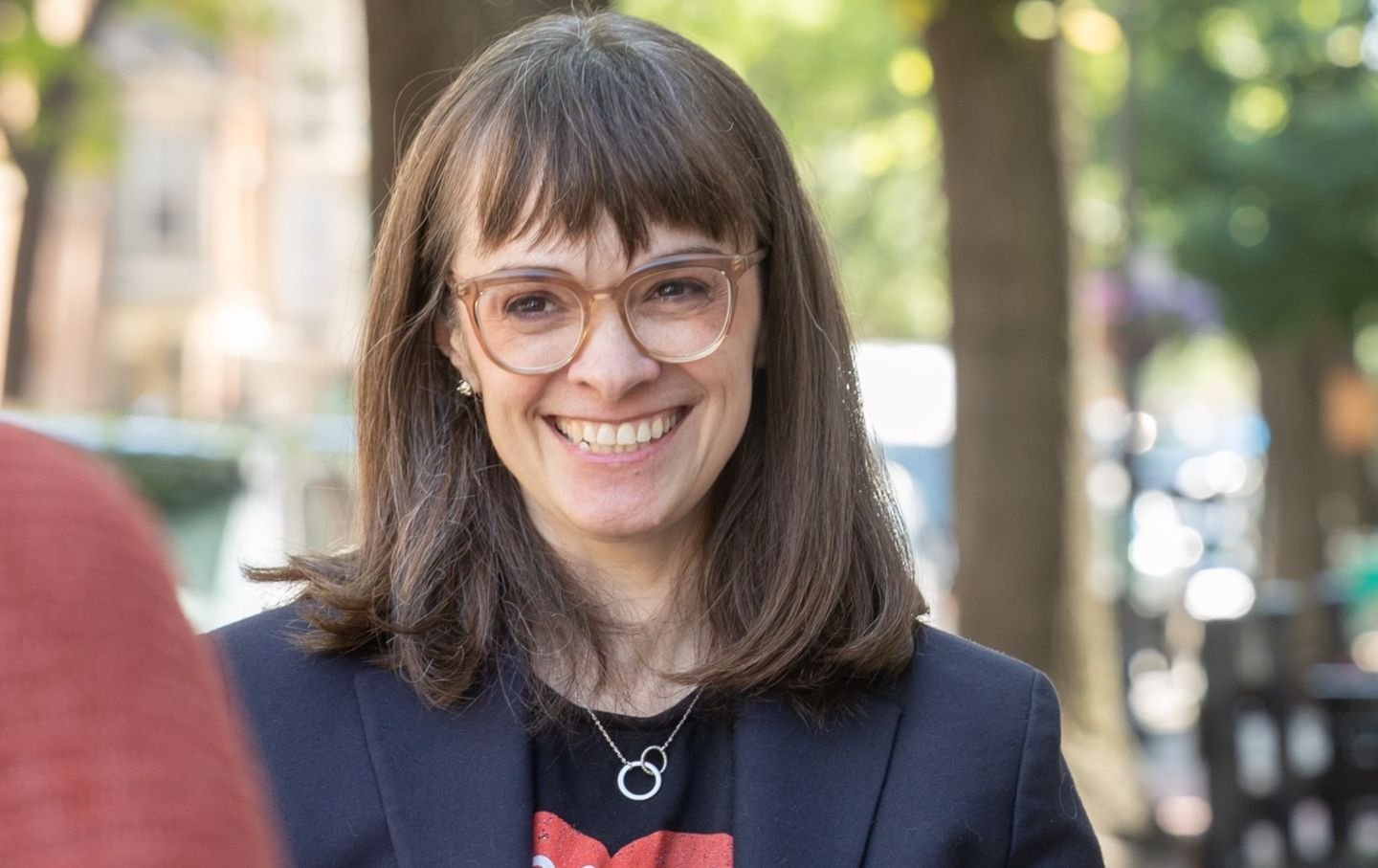
Back in 2011, when Maryland congressional candidate Alexis Goldstein first joined Occupy Wall Street, she was still shaking off the dog-eat-dog world of the Wall Street job she had just quit. In Occupy’s famously long and non-hierarchical meetings, she was relieved to find a space where people were valued not for making money but for the unique role they could play in feeding, caring for, educating, or organizing others. Goldstein soon became one of the movement’s leading financial experts—someone who could advocate for financial regulation, then use her Wall Street credibility to explain how they could work.
After Occupy, she continued to pursue the same goal of bringing the financial sector to heel as an employee of the Consumer Financial Protection Bureau, the federal agency designed to protect ordinary people from the predations of the finance sector, from payday loans to foreclosures. Goldstein is therefore an unusual figure: a movement wonk.
In 2025, Elon Musk’s notorious cohort of 20-somethings at DOGE invaded the CFPB. (“We put out a very surly press release about how we look forward to the smell of Axe body spray in our hallways,”Goldstein told me.) That February, Goldstein arrived at work from dropping off her child at daycare and noticed strangers without badges in the halls. She began filming them with her phone in her stroller’s cupholder. When she asked them who they were, and if they were trained to handle the agency’s sensitive data, they refused to answer her questions.
This was a red flag for Goldstein. By nature, the agency must deal with extremely sensitive information—everything from foreclosures to overdraft fees to car repossessions involve some degree of intimate disclosure, often made during one of the most vulnerable moments of a person’s life. She had also learned, while working on a project investigating payment platforms like Google Pay, Apple Pay, MetaPay, how valuable this information was to Big Tech companies. “All the very fancy lawyers for Google would tell us time and time again, ‘You’re asking us for this incredibly sensitive proprietary data that would be incredibly damaging to us if it ever got out,’” she said. Before Musk had started hoovering up agency data, he had talked about launching a payment platform, X Money. “I was like, ‘Oh, what a great way to undercut all of your competitors by going directly to the regulator that has all their sensitive data,” Goldstein said.
The DOGE members called security on Goldstein. Then, in January of this year, she was fired from the CFPB for “taking a vigilante approach,” according to reporting in Bloomberg News, that “put the Bureau off on the wrong foot with the new administration.” Now she’s running for Congress in her home state of Maryland against the incumbent, whose husband held the job before her, and the billionaire David Trone, among others.
When I call Goldstein on Zoom, she’s holding her five-month-old daughter and wearing a T-shirt featuring a skull emblazoned with the number 335—the local of her former union, the National Treasury Employees Union. “We don’t have to convince anyone that the billionaires are stealing from us,” she told me. “Everybody already knows. The public is so far ahead. On issues like data centers or even like abolishing ICE, Congress has yet to catch up.”
I spoke with Goldstein about her district and taking on America’s billionaires, data centers, immigration authorities, and the Israel lobby. This interview has been edited for length and clarity.
Sarah Leonard: Tell me about Maryland’s sixth district.
Alexis Goldstein: It’s a very gerrymandered district—it looks like the handle of Maryland. A lot of people work at educational institutions or research institutions. Then there’s three counties that are more rural: Washington County, Garrett County, Allegheny County. They’re much less populated, incomes are much lower, and the main employer tends to be the local government or a school, K-12 or higher education. In Garrett County, there’s no public transportation, there’s no public housing authority. But in Montgomery County and Frederick County, there are free buses—sort of like what Mamdani wants to do in New York. So there are some really cool things happening in the district, but it’s not well spread out.
SL: How can your specific background make you of service to this district?
AG: There’s a huge slumlord problem in western Maryland. People there have said, “You seem to know a lot of consumer lawyers—win or lose, will you come back and help connect us so we can fight these slumlords?” I am used to seeing like a policy person, so I’m like, “Oh, well that’s illegal [behavior]. We could just sue them.” Often people don’t even know it’s illegal. So given my policy background, my regulatory background, my networks, I’m seeing a real need that’s not being met.
SL: I know that you hope to continue to pursue financial regulation if you get elected and are aiming to sit on the Financial Services Committee. What can a congressperson do on that front right now?
AG: I have a three-point plan: Step one, find the billionaire money. Step two, take the billionaire money. Step three, give the billionaire money back to the people they stole it from.
For example, people hear a lot about private equity—because private equity is doing a lot with hospitals, privatizing hospitals and taking over pieces of them. Whether it’s hospital infrastructure, or privatizing parking meters and taking revenues away from local governments, they’re up to a lot of bad stuff. Private equity in total has $4 trillion in assets. One of the decisions that the Democrats made in the wake of the 2008 financial crisis, when they were passing the 2010 Wall Street Reform Act, was to bring more transparency to private equity. And they did the same thing to hedge funds. But they left out this thing called family offices.
Family offices sound cute, but they’re just the personal investment funds of billionaires. So it’s like Jeff Bezos’s personal investment fund, Elon Musk’s personal investment fund. And if you add up all of those billionaire family offices, there’s $6 trillion in them. That’s $2 trillion more than private equity, and we have no idea what they do with that money. It’s a huge black hole. That’s because there was a choice made: Politicians said, “Hey, they’re billionaires, they’re big boys”—and they’re pretty much always boys—“they can take care of themselves. They won’t ask for a bailout.” Which is not true. I worked with Alexandria Ocasio Cortez on a bill in 2021 that passed through the House Financial Services Committee to fix that. So that’s step one, find the billionaire money.
Once you know where the money is, you can do the effective stuff, like figuring out how to tax them in a way they can’t evade. I think there’s tons of taxing stuff you can do right away, and should do, like raise the cap on Social Security payments.
One of the things I’ve learned working on Wall Street and in government is the only mechanism we have to hold the elite accountable is taking their money away. That is the only thing that works, and it’s the only thing they recognize. And so I think that is the thing we should be laser focused on. I like to joke that I’ve worked in all of these different centers of power, like finance, and government, and lobbying the Hill, so it’s like I’ve cased the joint. Now I’m ready for the heist—which they heisted first. It’s our money.
SL: You’ve also been a big critic of crypto.
AG: It’s like we’re back to the golden age of fraud [before Roosevelt invented the Security and Exchange Commission] where you can just create a crypto token called Fartcoin and then sell it to a bunch of people. You have no idea where it comes from because it doesn’t come from anywhere. We made the CFPB [exactly for this reason]—because regulators dropped the ball on ordinary people.
This whole situation is just a repetition of when people were like, “Something’s weird with the housing market” before 2008. Or advocates were like, “This is bad. People are being preyed upon. Let’s pass some predatory-lending laws at the state level.” And Congress was like, “No, no, no, no, no.”
Now we have this huge movement against data centers, and people are like, “These are bad. They create no jobs. They make noise. It has no benefit to me. ” And Congress is like, “No, no, no, no, no. It’s fine. It’s the future.” Because of my regulatory background, I can be a validator for what people get intuitively.
SL: Speaking of data centers, there’s a big movement against them in your district right now.
AG: Yeah, people really hate them across the whole district. I’d say it’s bipartisan. In Frederick County, the local government essentially approved a data center, and all of these local people were like, “No.” They put together a ballot referendum and got 22,000 signatures to roll it back. All the normal things that can go wrong when you do a ballot referendum went wrong, and they overcame all of it. Every county I go to, whether it’s in the mountains in western Maryland or the more urban Montgomery County, closer to DC, nobody wants these things. Local politicians have had to change hearings about data centers into things like “information sessions.” They’re pitching people. It’s this really unifying thing that’s bringing together a lot of people of different political orientations.
SL: What do you think caused people to fight back so quickly? There are a lot of messed-up things happening right now, but the passionate opposition to data centers was fast and nationwide.
AG: Part of it is the billionaire aspect. It’s so clearly something that is using public funds, whether it’s a tax break or actual direct funding for billionaires. We know the names of the billionaires that are pushing these large language models on us. Everyone gets that [they provide] no jobs. There are like five jobs at the beginning to build the thing, and then it’s done. And one thing I’ve learned campaigning is they smell. I knew they were loud. I knew they had bad health impacts. I knew they drove up electricity—but they also smell bad. So you have a smelly, loud, expensive thing that’s going to take your money for the benefit of billionaires. What is there to like about something like that? Nothing.
I do think a big part of this is that people can take action locally. A lot of us feel overwhelmed by how little we can do to fight back. And this is something that’s so localized, that’s so specific. You can actually make a difference, and it will improve your life if you keep it out of your town or your city.
SL: What can you actually do about this from Congress?
AG: I’m supportive of Bernie Sanders and AOC’s moratorium on federal data centers, although I think that it doesn’t go far enough. The way it’s structured is essentially: Let’s pause and do a study. And I actually think we have all the information we need.
Popular
“swipe left below to view more authors”Swipe →
I’m a dork, so I read all of these securities filings from data center companies and companies leasing data centers to tech companies. And it’s all built on record-breaking amounts of debt. Essentially, $1.4 trillion has been spent by the tech industry on data centers. They’ve earned $600 billion in revenue. So they’ve spent more than twice what they’ve earned. There’s no use case.
I saw this happen in crypto when I was at the CFPB. We got things like, “It’s the future. It’s the early Internet. We don’t know what it’s going to do yet, but it’s going to be great. It’s technology.” And it turned out that was just hype from billionaires and venture capitalists. In 2007, 2006, there were states that were like, “We need predatory-lending laws. These mortgages are out of control.” And the federal government actually took steps to block those state laws, and we paid dearly for that. So I would like to see us invert it. I would like to see us ban AI data centers at the federal level.
To go back to all the complicated financial engineering of the 2008 crisis, at least it was built on this thing you could live in—a house. The instrument they’re using as collateral to back up all this debt for data centers is a graphics card, which becomes obsolete in two or three years because of advances in technology. Also, they run them so much for these large language models, they burn up. And so I don’t think a graphics card will always have value the way a house will, and I don’t think that’s well understood.
People don’t realize that when the Biden administration and the Trump administration banned China from getting the most sophisticated graphics cards, that forced them to [develop AI] in a less power-intensive way. And so we’re basically doing everything wrong. We’re throwing huge amounts of debt at this thing nobody really wants to pay for. The CFO of OpenAI said in 2025 that there should be a federal backstop, and he had to walk it back.
The tech industry has done a really good job over and over again of socializing the risk when they make mistakes and pushing it onto us.
SL: Another issue that people are organizing around in your district is ICE—what does that grassroots movement look like?
AG: I would say there’s two kinds of anti-ICE organizing. There’s mutual aid, like the Montgomery County Immigrant Rights Collective—that started last year, with four people, and now there’s thousands involved in chapters throughout the state. And then we have a Department of Homeland Security warehouse they’re trying to build in Washington County, and there’s a huge amount of political organizing targeting local officials to try to prevent this from happening.
It’s been pretty inspiring, because the folks on the ground have tried everything they could think of: There was no environmental review done for the warehouse, and someone raised a formal complaint about that. There isn’t enough water: There are four bathrooms in this warehouse that they want to house 1,500 people in. So people have raised the water issue. People have been going to council meetings, but the council doesn’t let people give public comments—so people figured out how to bring in signs. It’s really united the community. Nobody wants this warehouse, and it’s led to a slate of local people running for office.
I’m sure this is no surprise to readers of The Nation, but the data centers and the detention centers are connected. How do people end up in the detention center? There’s this surveillance dragnet that companies like Palantir have built and sold to the Trump administration and past Democratic administrations. And so getting rid of the data centers is connected to closing the detention centers.
I want to abolish ICE. I think we need to really, really, really significantly reduce the huge amounts of funding that are going to immigration enforcement. We could also decriminalize border crossing if we get a Democratic trifecta. Then you wouldn’t have the weapon of deportation or the weapon of the detention center.
We’ve built a detention machine that needs to be fed. And I think we’re fighting really hard right now not to increase that machine, but we need to dismantle it.
SL: I know Palestine has also been an important topic in your district. What are people in the district saying to you about that?
AG: The number-one question I get from potential constituents is, “Where are you on Gaza? Where are you on an arms embargo for Israel?” People really, really want an arms embargo. People are very supportive of the Block the Bombs Act.
I’m Jewish. I was raised in this concept of pikuach nefesh, the idea that the greatest thing you can do is save a life. It’s been hard to watch Judaism be weaponized to justify genocide in Gaza. It’s taught people to organize and brought people to say, “You know what? I reject the status quo. Let’s try something different. This is not working.”
One of my critiques of the Democratic Party is that they constantly punch down to their base. People say things like, “You really have to get the younger voters.” And I’m like, “The Democratic Party did the worst thing they could possibly do to younger voters during the Biden administration.” There was this organic, nationwide, grassroots movement, hyper-focused on universities: Let’s divest from Israel because there’s a genocide in Gaza. And the Democrats didn’t embrace it. They worked with local officials and law enforcement to crush it. They did the same thing they did with Occupy.
I think that issue has shown a lot of people, not just younger people, that we could have a different way. I was at a US Student Association conference two years ago, and we were doing a sort of envisioning session, and this student was like, “When we were protesting for Palestine on campus, there were nurses that were volunteering, people were sending us food. We had this whole community set up.” She was like, “It made me imagine how much different the world could be if we just funded different things.” It reminded me of my experience at Occupy. The campus occupations helped this new generation see it too—that, actually, we could do this.
With the midterm elections now firmly upon us, the question is whether Democratic candidates will do more than merely occupy ballot lines as mild alternatives to the red-hot crisis that is Donald Trump.
As Trump spends over $1 billion a day on a globally destabilizing war on Iran and admits that he doesn’t “think about Americans’ financial situation,” millions across the country are struggling with the surging costs of essentials. Democrats must seize this moment and advance bold, small-“d” populist ideas—not settle for cynical caution that once again snatches defeat from the jaws of victory.
The Nation elevates progressive ideas, movements, and elected officials achieving real change across the country into the national conversation. At the same time, our journalists are exposing how crypto and AI-funded super PACs are spending hundreds of millions of dollars to knock out candidates they oppose, reporting on the devastating impact of the Supreme Court’s evisceration of the Voting Rights Act, and sounding the alarm on attempts by red states to quickly redraw electoral maps, disenfranchising Southern Black voters.
We can play this critical role because of support from readers like you. This June, we’re raising $20,000 to power The Nation’s independent journalism in the run-up to November’s immensely consequential elections.
It’s in our power to build a more just society, and your support at this critical moment brings us closer to that bold vision. I hope you’ll donate today.
Onward,
Katrina vanden Heuvel
Editor and Publisher, The Nation
More from The Nation
A super PAC bankrolled by tech billionaires is trying to sink my run for Congress. What happens here will tell every other politician whether AI can be checked at all.

Twenty-five years after libertarians began migrating to New Hampshire to consolidate power, young politicians are deciding whether to embrace their vision—or resist it.

This is an all-hands-on-deck moment to save cultural and press freedom.

The negotiations are a stark symbol of the president’s failure. But any deal is better than endless, foolish war.

